
The Words ‘A Little’, ‘Can’ & ‘Kaypoh’ Are Now in the Oxford English Dictionary
The development of language continues to change over time, including the emergence of new words that reflect the way society communicates today.
From the everyday casual conversations of Malaysian people, especially when cooking, the word ‘agak-agak’ is now included in the Oxford English Dictionary (OED).
According to the dictionary, quit is used in Malaysia and Singapore, especially in cooking.
This means an estimate or guess, not a definite measurement. The word is also often used as a modifier.
The word was first used in the 1970s and the earliest evidence is in the newspaper New Nation (Singapore) in 1975.
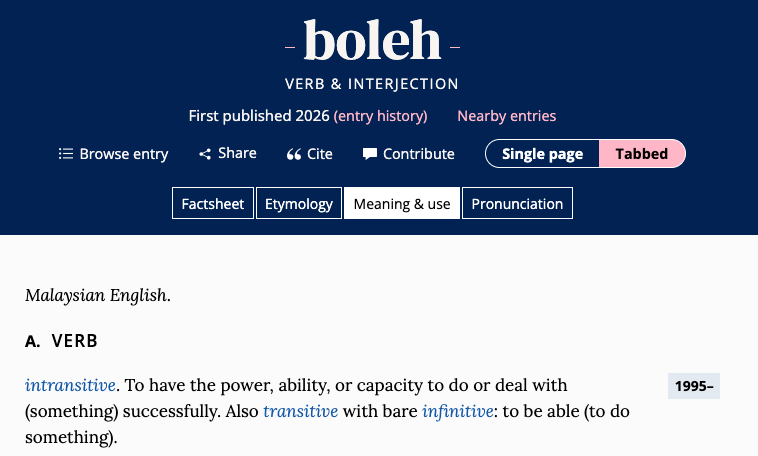
Apart from that, the word ‘can’ is also included in the dictionary.
‘Can’ was first recorded in the New Straits Times in 1995.
‘Can’ refers to two meanings involving the use of the verb for the purpose. According to the OED, ‘can’ means having the power, ability or capacity to do something or handle (something) successfully.
Popularized by the advertising slogan Malaysia Boleh, part of the Milo chocolate drink marketing campaign encouraging support for Malaysian athletes during the Southeast Asian Games held in Singapore in 1993.
“The phrase later became a widely used rallying cry in Malaysian sports and politics,” he said.
For use with an exclamation mark it means expressing approval, concession or agreement (‘yes’, ‘okay’).
It is also used interrogatively at the end of a statement, to ask for agreement or confirmation (‘okay’?).
The dictionary also updated the word Kaypoh which has two meanings. As for the noun, ‘kaypoh’ is a person who likes to annoy or tease, a person who interferes in other people’s affairs without being invited, and a person who likes to meddle in other people’s affairs.
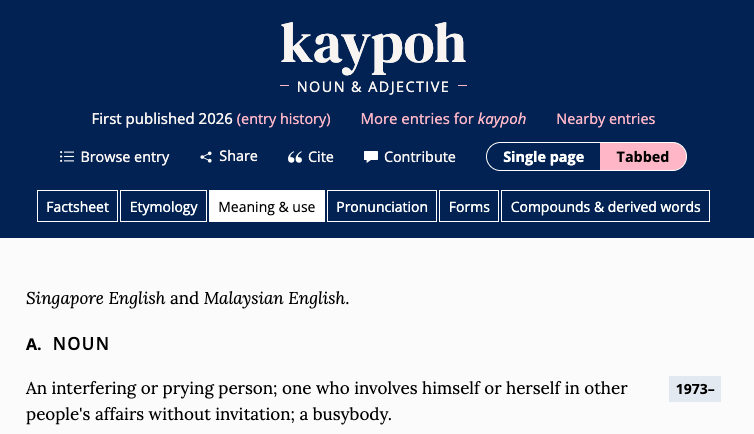
As for the adjective, ‘kaypoh’ means meddling, curious and busy.
The word ‘kaypoh’ was first used in 1973 and is a loan from Chinese.
PakarPBN
A Private Blog Network (PBN) is a collection of websites that are controlled by a single individual or organization and used primarily to build backlinks to a “money site” in order to influence its ranking in search engines such as Google. The core idea behind a PBN is based on the importance of backlinks in Google’s ranking algorithm. Since Google views backlinks as signals of authority and trust, some website owners attempt to artificially create these signals through a controlled network of sites.
In a typical PBN setup, the owner acquires expired or aged domains that already have existing authority, backlinks, and history. These domains are rebuilt with new content and hosted separately, often using different IP addresses, hosting providers, themes, and ownership details to make them appear unrelated. Within the content published on these sites, links are strategically placed that point to the main website the owner wants to rank higher. By doing this, the owner attempts to pass link equity (also known as “link juice”) from the PBN sites to the target website.
The purpose of a PBN is to give the impression that the target website is naturally earning links from multiple independent sources. If done effectively, this can temporarily improve keyword rankings, increase organic visibility, and drive more traffic from search results.
